
Deciding to forgo car ownership can save you money on recurring expenses like gas, insurance, oil changes, etc. However, you’re still likely to find yourself in situations where a car is necessary.
Previously, renting a car meant going to a rental location and using rental car companies like Enterprise or Avis. Unfortunately, opting for rental cars often resulted in paying exorbitant rental prices and hidden fees.
Luckily, Turo can help you rent a car at an affordable rate. This Turo review will discuss how the platform works, how much it costs, its key features, and more.

Overall Rating
Summary
Turo is a peer-to-peer car rental marketplace that allows customers to rent vehicles directly from owners rather than car rental companies. It’s quick and easy to use for both hosts and drivers, allowing hosts to earn extra money while drivers can either save money on rentals or find unique vehicles they may not find elsewhere.
-
Ease of use
5
-
Cost for drivers
4.5
-
Customer service
4.5
-
Locations
4
-
Payout for hosts
3.7
Pros
- User-friendly website and app
- Earn to pay off car payment
- Prices cheaper than most
- Multiple pickup/dropoff locations
- Ability to rent under 25 years old
Cons
- Complex host payout in tiers
- No one-way rentals
- Limited in rural areas
- Protection plans don’t cover everything
Table of Contents
What is Turo?
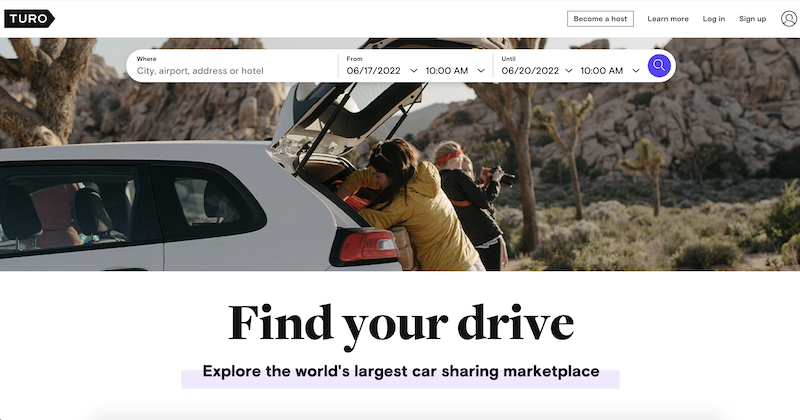
Turo car rental is a peer-to-peer vehicle rental service headquartered in San Francisco. It is essentially Airbnb for cars. The company allows people with unused vehicles to rent them to people who need them. This service presents opportunities for both car owners and drivers.
First, people who are paying for a car they don’t use frequently can rent it out for extra cash, which can be a way for them to earn passive income. On the other hand, someone who needs a car for occasional use while traveling or doesn’t want the responsibility of owning a car can easily rent a vehicle when needed.
Better yet, renting vehicles through Turo can be more affordable since local car owners tend to charge less than major rental companies. Whether you need a replacement vehicle, a vacation rental, or a car for your next business trip, Turo offers excellent car rental options.
Is Turo Legit?
Yes, Turo is the world’s largest car-sharing service. Turo has set itself apart from any competition with an excellent near 5-star app rating and over 300k reviews between Google Play and Apple App downloads. Turo offers an in-depth terms of service outlining its use policy, eligibility, requirements, legal matters, and more.
You can book any car you want, wherever you want it, from a vibrant community of trusted hosts across the US, Canada, the UK, France and Australia.
Additionally, they have a vested interest in the sustainability of the environment. Turo offsets 100% of our estimated global carbon emissions by investing in greenhouse gas-reducing projects,
How Does Turo Work?
Turo is a peer-to-peer service, meaning customers rent vehicles directly from car owners through an app. This lets them avoid using a traditional car rental service.
For Car Owners
For car owners, Turo presents an opportunity to earn money by renting their vehicles to customers. Essentially, it’s a passive income stream.
Turo can generate some extra cash for people who aren’t using their vehicles regularly. Other business-minded people may see Turo as an entrepreneurial venture, buying vehicles to make money by renting them out on Turo.
To list your vehicle on Turo, it must be no more than 12 years old unless it qualifies for an exception as a specialty vehicle. It must also have fewer than 130,000 miles and be well-maintained.
When you’re ready to list your vehicle, you must verify your identity with Turo.
To list your vehicle, you’ll have to provide your:
- License plate number
- Vehicle make, model, and year
- Vehicle identification number
- Description of your vehicle
- Photos of your vehicle
When you list your vehicle, Turo will use automatic pricing to set your rate based on your location and changes in supply and demand. Drivers can turn off automatic pricing and set their own flat prices within a minimum and maximum threshold.
You can offer discounts for long trips and early-bird bookings, but you don’t have to.
Once customers start renting your car, you’ll start getting paid. Turo pays by direct deposit through Stripe. After your first trip, payout usually starts about three business days after the trip ends. After that, it starts about three hours after each trip ends, and your bank can take another three to five business days.
For extended bookings, you’ll receive weekly partial payments until the end of the trip.
For Drivers
Turo car rental allows drivers to rent cars directly from owners rather than through a vehicle rental company.
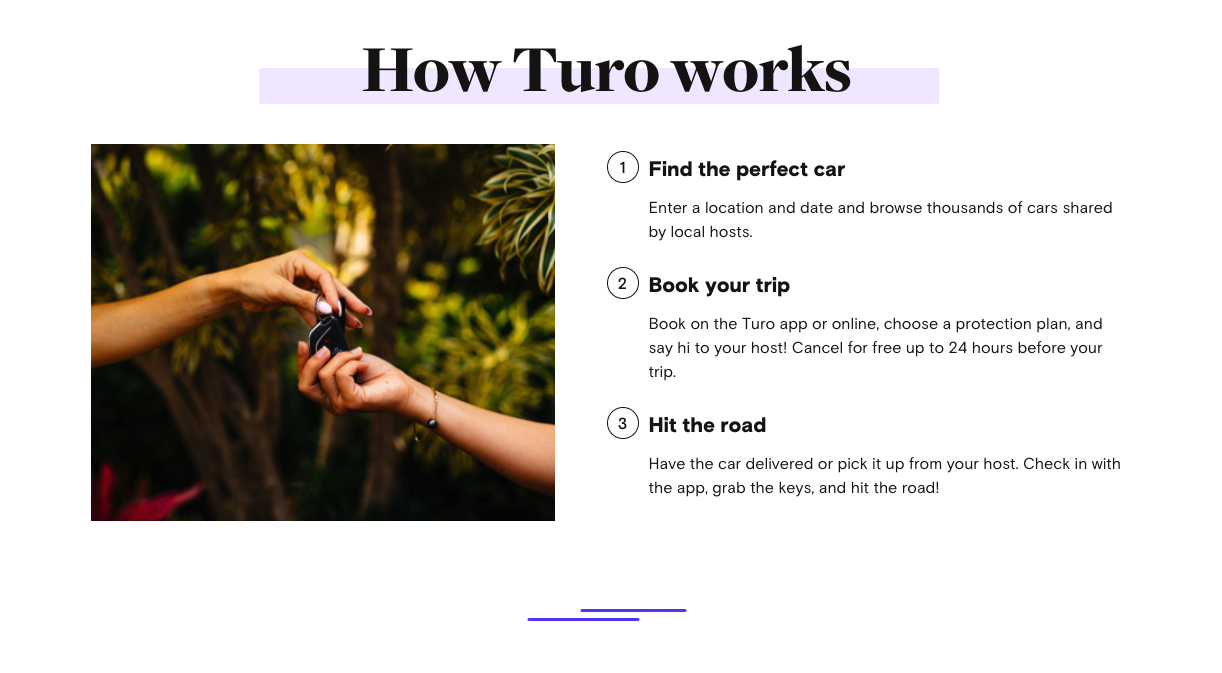
Before renting a car on the Turo app, you must be approved as a driver. You’ll share a profile photo, your contact information, and your driver’s license to do so. You can usually be approved immediately, but if your account is missing information, it may take as long as 24 to 48 hours.
To rent a car, you must be at least 21 years old. However, for specific vehicles, you must be 25 or 30. For trips with peer-to-peer hosts, you may be able to rent as young as 18 years old.
You’ll also need:
- A valid driver’s license
- Proof you’ve been driving at least two years if you’re under 25
- An auto insurance score that meets specific benchmarks
The booking process is fairly straightforward. Once your account has been approved, you can browse vehicles and book a trip. Rates start at just $25 per day but will be higher for newer or premium cars.
You can cancel your trip for a full refund up to 24 hours in advance, making Turo an excellent option for flexible car rentals. When it’s time to start your trip, you can pick up your vehicle directly from your host or have it delivered.
How Much Does Turo Cost?
Both vehicle owners and drivers will be subject to certain costs and rental fees when they use Turo.
For Car Owners
Turo can be a great opportunity to earn extra money, but you’ll also have to split some of your earnings with the car-sharing company.
The host’s take rate is the percentage of each trip that you earn as the host. Your take rate depends on the protection plan you choose, and U.S. hosts keep 70%, 80% or 90% of the trip price. In some cities, your share also goes up or down with how far ahead the guest books.
A host’s take rate doesn’t just include the daily cost. In the U.S., it also applies to Extras and delivery fees, while reimbursements like fuel, tolls and approved cleaning fees are paid to you in full. On most trips, Turo keeps 10%, 20% or 30% of the trip price, depending on your plan.
For Drivers
Renting a car starts at just $25 per day. Drivers can search based on daily rates to find a rental fee that fits their budget. While older and more basic vehicles might be priced in a lower range, others can cost hundreds of dollars per day.
For example, someone in Chicago a 2021 Tesla Model S can rent for more than $400 per day, but a decade-old Honda or Ford sedan could rent for less than $40. In addition to the rental cost, you’ll also be subject to a trip fee. This is a percentage of the trip price.
Your trip fee is calculated at checkout and depends on the vehicle’s value, how far in advance you booked, the length of your trip, and other factors. Another cost driver may be the protection plan they choose. You can decline protection altogether.
However, if you do choose to purchase insurance coverage, it will cost between 18% and 65% of the trip price, with a minimum daily charge ranging from $10 to $14 per day.
The final fee drivers may have to pay is a young driver fee. For drivers between the ages of 18-20, the young driver fee starts at $50 per day. If you’re 21-25, the fee will be a minimum of $30 per day.
Key Features
Turo has plenty of exciting features, making it an excellent option for car owners and drivers.
Turo Carculator
The Turo Carculator is a tool built into Turo’s website. It allows vehicle owners to determine how much they might earn by renting their cars on the Turo website.

You can filter results by region and vehicle budget range. From there, you’ll see vehicles priced in that range, the expected annual loan payments, and the average annual earnings. Finally, the Carculator will show you your estimated annual return on your investment.
Prospective drivers can use the Carculator to determine their expected earnings. However, it’s primarily geared towards people who want to establish this as a more substantial passive income stream.
Host Tools

Turo offers a variety of tools and resources on the website to help automobile owners boost their earnings.
Getting Started Guide
The Getting Started Guide teaches car owners everything they need to know about creating listings, optimizing their schedules, and more.
Photography Guide
Pictures are everything. To help increase the odds that a vehicle owner’s listings will be noticed, Turo offers a photography guide that teaches best practices.
Cleaning & Disinfecting Guide
This guide teaches owners about best practices for cleaning their vehicles, helping to protect the health and safety of both drivers and owners.
Contactless Check-In Guide
This guide teaches hosts how to maintain physical distance from their renters by checking in with their guests remotely.
Vehicle Protection Guide
This guide helps hosts navigate the different protection plans available and choose the best one.
Deals & Discounts
Turo hosts have access to various discounts on services such as Jiffy Lube, Meineke, YourMechanic, and more.
Turo Talk
All Turo hosts can join Turo Talk, a moderated Facebook group for discussing everything related to renting out a car on Turo.
Turo Incident Info Card
Turo provides every host with an incident information card and insurance card to keep in their vehicle’s glove box.
Insurance and Protection
Every U.S. host earnings plan includes up to $750,000 in third-party liability insurance through Travelers, which covers injury or damage to other people, not your own car. New York hosts get different limits.
The plan you pick sets both your share of each trip and how much you pay if your car is damaged. Turo then reimburses eligible repairs above that amount, up to the car’s actual cash value or $200,000, whichever is less. Turo notes that it is not an insurance company and that this reimbursement is contractual, not insurance.
There are three earnings plans for U.S. hosts:
| Earnings plan | You keep | Your damage responsibility |
|---|---|---|
| More peace of mind | 70% of the trip price | $250 per trip |
| Balanced | 80% of the trip price | $1,500 per trip |
| More earnings | 90% of the trip price | $2,750 per trip |
None of the plans pay for wear and tear (including dings, dents and scratches three inches across or smaller), lost hosting income while your car is being repaired, or a replacement car. You still need your own personal car insurance, which usually won’t cover the car during a Turo trip.
Sustainability

Turo became the first car-sharing marketplace to become carbon-neutral, meaning it offsets 100% of its estimated global carbon emissions.
Turo buys carbon offsets by investing in emission reduction projects through the carbon offset developer Bluesource to meet this commitment.
The money goes toward projects that fight climate change, reduce carbon emissions through forestry, and improve commercial trucking efficiencies.
Turo Shop

The Turo Shop offers a couple of resources for vehicle owners.
First, it has a Spiffy Complete disinfectant kit that includes:
- A bottle of disinfectant cleaner
- Microfiber towels
- A cleaning checklist that drivers can hang in the window
The other product Turo sells in its shop is a no-smoking sign that hosts can hang in the vehicles to remind customers not to smoke. The sign also reminds customers that smoking in the car will result in a fine and a ban from Turo.
Turo Car Rental Reviews
Before using any service, it can be helpful to know what other customers have to say to ensure it’s legit.
Here’s how Turo stacks up across the various rating websites:
| Website | Rating | Total Reviews |
| Google Play | 4.9 out of 5 | 147k |
| Apple App Store | 4.8 out of 5 | 178k |
| Trustpilot | 4.6 out of 5 | 28k |
| BBB | 1.04 out of 5 | 350 |
These are a few of the Turo reviews from customers:
“Using Turo was fantastic. The host was wonderful, the car was perfect for us, and so easy to find and return.” – Bron L
“Terrible. This app allows scammers to work freely and openly with no regard for the customer.” – Jon M
“Everything was simple and seamless! I will certainly use Turo again.” – Amanda G
“After having the worst rental experience of my life, I looked at my bank this morning and realized you guys charged me an extra fee…. I’m so disappointed in your business ethics. Definitely appears like you do not value your guests!” – Augustine
Alternatives to Turo
If you aren’t sure that Turo is the best option, there are plenty of other platforms to consider. Here are a few alternatives to Turo.
Uber Rent
Uber Rent lets you book a rental car in the Uber app from companies like Avis, Budget and Thrifty, plus Zipcar and even Turo cars. You compare prices before you book, and in-app reservations can be canceled for free up to 48 hours before pickup, subject to the rental company’s rules.
The minimum age is 18, but rental companies can set a higher age and charge under-25 fees. Uber One members also get a price match and 10% back in Uber One credits, up to $250, on eligible rentals.
Getaround, which we used to list here, ended its U.S. operations on February 12, 2025, and now offers car sharing only in Europe.
Uber and Lyft Driver Rental Programs
If you want a car to drive for rideshare or delivery apps and earn extra money with your side hustle, the rideshare companies rent cars through their own partners. Insurance and maintenance are built into the weekly price.
- Uber’s Vehicle Marketplace: Hertz rentals start at $240 a week plus taxes and fees, with insurance, basic maintenance and unlimited miles included and a $200 refundable weekly deposit. Avis rentals start at $260 a week plus taxes and fees, with no security deposit and up to a $1,000 deductible if the car is damaged.
- Lyft Express Drive: rents Flexdrive and Hertz cars to Lyft drivers, with insurance, standard maintenance and roadside assistance included and no long-term contract. Lyft doesn’t list prices on its page.
HyreCar, the rideshare rental marketplace we used to recommend here, shut down in 2025. Old promo codes no longer work. Read what happened to HyreCar.
ZipCar
ZipCar is a platform that allows you to rent a car by the hour or day, depending on your needs. It operates in the U.S., Canada, and other countries. Unfortunately, it doesn’t cater to people who want to earn extra income using their cars.
It’s easy to sign up for the service, drive on demand, and then return the car. Rates vary by the type of car, how long you need to use it, and how far you plan on driving. Zipcar charges a non-refundable $25 application fee, and gas, insurance options and maintenance are included in its rates.
FAQ’s About Turo
Before you sign up for Turo car rental, these frequently asked questions can help you determine if the platform is right for you.
Yes, Turo is safe to use. Every host earnings plan includes up to $750,000 in third-party liability insurance and reimburses eligible repairs, but hosts still pay a damage responsibility of $250 to $2,750 per trip, and wear and tear isn’t covered.
Turo also makes it easy for hosts and drivers to interact while maintaining a safe social distance.
According to Turo, U.S. hosts earned an average of $10,489 per car in 2025, before costs like maintenance and insurance. Your potential income increases with the number of vehicles you have listed.
Of course, the amount you can earn depends on whether your car is listed only during certain times or is always available to rent.
Rental cars from traditional car rental companies can be expensive. Luckily, vehicles on Turo start at just $25 per day and don’t come with many added fees that rental companies charge.
The exact amount you can save depends on many factors, including where you live, the type of car you’re renting, the distance you’re driving, and more.
Turo has a couple of different ways for users to get in touch with a Turo customer service representative. The website has a chat feature where you can speak with someone online.
Additionally, Turo has a customer service phone number that’s available 24/7 in the United States.
Summary
Turo brings together those who need vehicles with those who have them, allowing individuals to bypass traditional rental companies and rent cars directly from one another.
It can be an earning opportunity for hosts, whether you’re just listing a vehicle you don’t use often or are starting a full-fledged business.
Alternately, drivers can rent vehicles just to get around for the day or for a long road trip. Whether you are looking for a way to earn money renting out a car or save money on a rental, Turo is worth checking out.
Recommended Reading
Looking for more ways to earn? See more driving and car side hustles in our list of side hustle ideas.