A good credit history can open the door to better financing on major purchases. Over the life of a big loan, like a mortgage, a higher credit score can save you thousands of dollars.
Chime Credit Builder was Chime’s secured credit card for building credit without an annual fee, interest or a security deposit. Chime has since renamed it the Chime Card, changed how money moves into it and added cash back for some members. I checked the card’s terms, fees, requirements and credit reporting on Chime’s own site and card agreement in November 2026.
Summary
The Chime Card (formerly the Chime Credit Builder Secured Visa Credit Card) offers a twist on the traditional secured credit card. Its specialized features will help you build credit and unlock more attractive financing on major purchases.
Pros
- No annual fees
- No interest charges
- Reports to all three major credit bureaus
Cons
- Must open a Chime Checking Account
- Cash back needs qualifying direct deposits
- No unsecured credit card options available
Quick answer
Chime Credit Builder is now called the Chime Card, and it’s still a good, low-cost way to build credit if you bank with Chime. It’s a secured Visa credit card with no annual fee, no interest, no credit check and no minimum deposit, and Chime reports your payments to TransUnion, Experian and Equifax without reporting utilization. You need a Chime Checking Account, but direct deposit is now only required for its 2% or 5% cash back (as of November 2026).
Table of Contents
Chime Credit Builder Is Now the Chime Card
Chime calls the Chime Card “the next generation of Credit Builder.” It’s still a secured Visa credit card that you use with a Chime Checking Account, and it still has no annual fee, no interest and no credit check to apply. Chime moved existing Credit Builder members to the Chime Card, and it says the switch can’t be reversed.
The biggest changes are how the card is funded and the new rewards. Money you deposit to Chime now flows into the card’s secured account automatically, and members with enough direct deposits can earn cash back on a category they choose.
| Feature | Chime Card (as of November 2026) |
|---|---|
| Card type | Secured Visa credit card |
| Annual fee, interest, late fee | None |
| Credit check to apply | None, and applying doesn’t affect your scores |
| Minimum security deposit | None |
| Credit limit | No preset limit; you can spend what’s in your secured account |
| Credit reporting | TransUnion, Experian and Equifax; utilization not reported |
| Cash back | 2% (Chime+) or 5% (Chime Prime) on a category you choose, up to $1,500 in eligible purchases |
| Foreign transaction fee | None |
| ATM cash | Free at 47,000+ in-network ATMs; $2.50 out of network or over the counter |
| Requirement | A Chime Checking Account; direct deposit only for cash back and some perks |
How Does the Chime Card Work?
To apply, you need a Chime Checking Account. When you open the Chime Card, Chime also opens a Secured Deposit Account for it. The money in that account is collateral for the card, and you can spend up to that amount.
Under the current card agreement, Chime automatically moves deposits and transfers into your Checking Account over to the Secured Deposit Account. When you make a debit card purchase or another Checking transaction, Chime moves the money back as needed. Cash you deposit at a retailer goes to the Chime Card account first.
There’s no preset credit limit. Your spending power is simply the money in your account, and the card won’t let you spend more than you have, so you can’t build up high-interest debt with it.
Older versions of Credit Builder required a qualifying direct deposit of $200 or more before you could apply. Chime now says direct deposit isn’t required to get the Chime Card. You only need qualifying direct deposits for cash back and other membership perks.
Paying Your Balance and Safer Credit Building
Statements are available by the 28th of each month, and payment is due on the 23rd of the following month. You owe the full balance each month, and there’s no minimum payment.
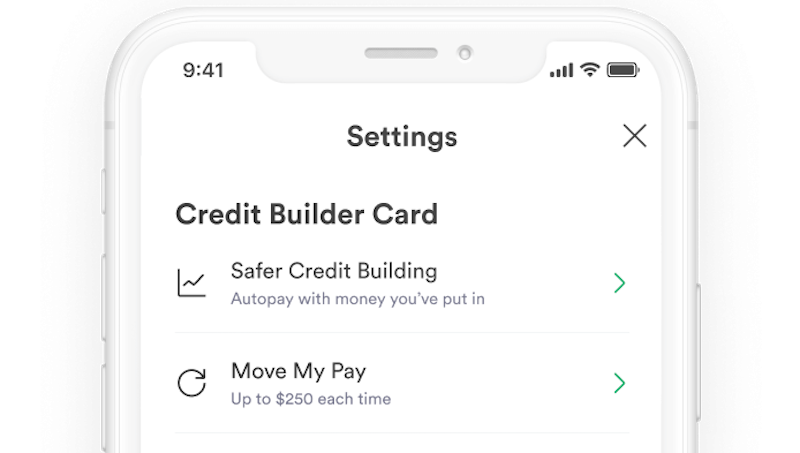
Safer Credit Building is an optional feature that pays your monthly balance automatically, on time, with money from your secured account. You can also pay manually in the app or send an ACH payment from another bank.
Chime doesn’t charge late fees or interest. If you don’t pay your statement balance within 24 days of the due date, though, Chime pauses the card for new purchases, and late or missed payments may be reported to the credit bureaus. Paying the full balance turns the card back on.
Chime Card Fees
The Chime Card is close to free, which is rare for a credit-building product. Here’s what the card agreement and Chime’s card page list.
| Fee | Cost |
|---|---|
| Annual, application, maintenance | $0 |
| Interest | None (no APR) |
| Late payment | $0 (the card is paused instead) |
| Foreign transactions | $0 |
| Cash at in-network ATMs | Free at 47,000+ ATMs |
| Cash at out-of-network ATMs or over the counter | $2.50, plus any ATM owner fee |
| Replacement plastic card | $0 ($20 to expedite) |
| Metal card | Up to $50 plus sales tax |
Fee-free ATMs include Allpoint ATMs, Visa Plus Alliance ATMs in the Allpoint network and FCTI ATMs in 7-Eleven stores. When you take cash at an ATM with the Chime Card, it counts as a cash advance, but there’s no interest and no Chime fee in network. At account opening, cash advances are limited to $1,015 a day (or your available amount, if lower).
Key Features of the Chime Card
The Chime Card can help improve your credit score, and it has a few other features that set it apart from a typical secured card.
1. No Traditional Security Deposit
A traditional secured credit card asks for a fixed deposit, often a few hundred dollars, and that deposit sets your credit limit. The Chime Card has no minimum security deposit. The money in your Chime account works as your limit, and it changes as your balance changes.
2. No Interest Spending
When you use the Chime Card, you’re spending money you’ve already put aside, so there’s no interest. That makes it a safer choice than a regular credit card if you’re worried about running up credit card debt.
3. Credit Reporting to All Three Bureaus

Chime reports your Chime Card activity to TransUnion, Experian and Equifax at the beginning of each month. It shares your payment history (on time, late or missed), how long the account has been open and your balance. The changes can take a few weeks to show up on your reports.
The card is issued by The Bancorp Bank, N.A. or Stride Bank, N.A., so the account on your credit report may list Chime together with its issuing bank.
Chime cites an Experian study from September 2025: across all study participants, scores rose 28 points on average, and the top 10% of members who made their first Credit Builder purchase between April and August 2024 saw a FICO Score 8 increase of 71 points after about eight months. Chime notes that results aren’t guaranteed and that your other credit activity matters too.
4. Credit Utilization Isn’t Reported
Credit utilization is another big factor in your score. It compares how much credit you use to how much you have. For example, if you have a $1,000 limit and a $600 balance, your utilization is 60%. Most experts recommend keeping it under 30%.
Secured cards often have low limits, which can push utilization up. Because the Chime Card has no preset limit, Chime doesn’t report a limit or a utilization rate to the bureaus.
5. Cash Back for Chime+ and Chime Prime Members
The Chime Card adds cash back if you have enough direct deposits. Chime+ members earn 2% cash back, and Chime Prime members earn 5%, on a category they choose, on up to $1,500 in eligible purchases.
Chime+ status needs a single qualifying direct deposit of $200 or more, or $400 or more in total, in the past 34 days. Chime Prime needs $3,000 or more in qualifying direct deposits in the past 34 days. Neither tier has a fee.
6. SpotMe on Credit
SpotMe on Credit is an optional overdraft line tied to the Secured Deposit Account, with no interest and no fees. You need $200 or more in qualifying direct deposits to your Chime Checking Account each month. Limits start at $20 and may grow to $200 or more based on your account history.
7. No Hard Credit Check
There’s no credit check to apply, and Chime says applying doesn’t affect your credit scores. A low score or thin credit file won’t keep you from getting the card.
Things to Know Before You Apply
- You need Chime Checking. The Chime Card only works with a Chime Checking Account, so it’s best if you’re happy banking with Chime.
- Money moves automatically. Deposits flow into the card’s secured account. To stop those automatic transfers, Chime says you have to close both the Chime Card account and the Secured Deposit Account (you can keep Checking).
- Closing is permanent. Closing the card could hurt your credit score, and Chime says you can’t open a new Chime Card account afterward.
- Missed payments still count. There are no late fees, but late or missed payments can be reported and lower your score.
Chime Customer Reviews
There aren’t many reviews of the Chime Card on its own, but Chime as a whole is rated highly in the app stores and lower on Trustpilot, where reviews often mention account and support problems.
| Website | Rating | Number of reviews (November 2026) |
|---|---|---|
| Apple App Store | 4.8 out of 5 | About 1.7 million |
| Google Play | 4.7 out of 5 | About 1.1 million |
| Trustpilot | 3.4 out of 5 | About 14,000 |
You can reach Chime’s Member Services 24/7 by chat in the app or by phone at (844) 244-6363.
Alternatives to the Chime Card
The Chime Card isn’t the only way to build credit. Here are other options worth comparing, plus more in our list of credit building apps.
1. Credit Strong
Credit Strong is a division of Austin Capital Bank, an FDIC-insured Texas state savings bank. Its installment accounts work like a credit builder loan: the bank puts the loan money in a locked savings account, you make monthly payments, and you get the principal back at the end of the term, minus any unpaid interest or fees.
You pay a non-refundable administrative fee plus interest. One example on its site is $28 a month for 48 months on a $1,010 account at 15.61% APR. Credit Strong reports to all three bureaus and isn’t available in Vermont or Wisconsin. It also offers Revolv, a revolving credit builder for $99 a year.
2. Self
Self offers a Credit Builder Account. Self holds your loan in a certificate of deposit while you make monthly payments, and at the end of the term you get the money back, minus interest and fees. Self also offers a secured credit card and can report rent and bills.
3. Extra
The Extra Debit Card is the most similar option to the Chime Card for people who don’t want to switch banks. It connects to your existing bank account, sets a spending limit based on your balance with no credit check, and reports your purchases as on-time payments.
Unlike Chime, Extra charges a membership fee: $20 a month or $149 a year for Credit Building, or $25 a month or $199 a year with rewards. It reports to Equifax and Experian, not TransUnion. You can also monitor your credit while you use it.
Frequently Asked Questions
Is Chime Credit Builder still available?
Chime Credit Builder is now the Chime Card. Chime moved Credit Builder members to the Chime Card, which is still a secured Visa credit card with no annual fee or interest, and the change can’t be reversed.
Does the Chime Card report to all three credit bureaus?
Yes. Chime reports your Chime Card payment history, account age and balance to TransUnion, Experian and Equifax at the beginning of each month. It doesn’t report a credit limit or utilization, because the card has no preset limit.
Do you need direct deposit for the Chime Card?
No. As of November 2026, Chime says you only need a Chime Checking Account to get the Chime Card. Qualifying direct deposits are needed for cash back (2% with Chime+ or 5% with Chime Prime) and for SpotMe on Credit.
Can the Chime Card hurt your credit?
Yes, it can. Chime doesn’t charge late fees, but late or missed payments may be reported to the credit bureaus and lower your score. Turning on Safer Credit Building pays your balance automatically on time, and closing the card could also affect your score.
How much can the Chime Card raise your credit score?
There’s no guaranteed increase. Chime cites a September 2025 Experian study where participants’ scores rose 28 points on average, and the top 10% saw a 71-point FICO Score 8 increase after about eight months of on-time payments.
Summary
The Chime Card keeps what made Chime Credit Builder appealing: no annual fee, no interest, no credit check and no minimum deposit, with reporting to all three credit bureaus. It’s now easier to get, since you no longer need a direct deposit to apply, and Chime+ and Prime members can earn cash back.
The main trade-off is that it only works with Chime Checking, and your deposits flow into the card’s secured account automatically. If you’re comfortable banking with Chime and you’re trying to clean up a bad credit history, the Chime Card is worth considering. If not, compare other debit cards to build credit or checking accounts for bad credit.
Disclaimer: Chime is a financial technology company, not a bank. Banking services provided by The Bancorp Bank, N.A. or Stride Bank, N.A., Members FDIC. The Chime Card is issued by The Bancorp Bank, N.A. or Stride Bank, N.A.
Self is not a bank. Credit Builder Accounts & Certificates of Deposit made/held by Lead Bank, Sunrise Banks, N.A., or First Century Bank, N.A., each Member FDIC. Subject to credit approval.